
I suspect that the team advising Premier-designate Doerkson on getting ready to take the reins of power towards the end of November are experiencing wild mood swings as they work their way through what I guess would be approximately eight feet of briefing binders that the B.C. Public Service had dutifully put together during the election period. No doubt there will be periods in which they are jubilantly excited about the prospects of taking on those reins. I am just as sure that there will be periods in which they become deeply anxious as they contemplate all the issues which they will have to manage. Issues which have no easy solutions – in fact, the essence of government is that there are often no solutions to society’s problems, only politically-difficult trade-offs.
There are four key tasks that the transition team will be focusing on over the next three weeks:
Getting fully briefed on all the issues facing the Province.
Thinking through how, if at all, the new government would like to restructure government ministries.
- Is the new government content to start off with the same complement of ministries as the outgoing government?
- Does it want to reduce the number of ministries?
- Are there new ministries it would like to establish?
- Does it want to significantly reorient the focus of some ministries?
Making key personnel decisions
- The initial makeup of cabinet
- Which of the 63 elected MLAs will be asked to sit at the cabinet table, and in what portfolios?
- This will be the first substantive test of Premier Doerkson’s management and team-building skills. Most of those 63 MLAs will not be included in the first cabinet. How will Premier Doerkson manage their disappointment?
- Staffing of the offices of the Premier, Ministers, Government Caucus and Government Communications
- The initial roster of Deputy Ministers – the senior professional public servants in each Ministry
- Which of the 63 elected MLAs will be asked to sit at the cabinet table, and in what portfolios?
Deciding on the government’s early priorities
Every new government comes to office with a very ambitious agenda. It knows all the things that need to be fixed, all the enhancements to public services that are required, all the changes that will strengthen the economy, and so on. It is only natural that it will be impatient to get on with doing all of that as soon as possible.
If the impulse to pursue all that agenda immediately is not checked, the government almost surely will fail. Government is significantly more complex, the trade-offs between competing objectives are much more profound, and the structure of the Westminster system of government is much less efficiently operational than people suppose before they are on the inside.
What are the relatively few priorities for the first six months that the new government will focus on? Getting that right will be absolutely critical to the success of Premier Doerkson’s administration.
What Should be Priority One?
In my opinion, the top priority for the new government must be dealing with the big elephant in the room – dealing with the Province’s currently unsustainable fiscal path. If the new government cannot put the Province onto a path to fiscal sustainability within its first year– I will discuss what that might look like below – then it will find that its capacity to address the public’s expectations for essential services will diminish steadily each year. The public will see that it is getting less and less for the taxes it is paying – rarely a winning situation for a government hoping to be re-elected in the next general election.
The best single measure of whether a jurisdiction’s fiscal situation is sustainable is the ratio of taxpayer supported debt to GDP. If this ratio is stable, the fiscal situation is stable. If, on the other hand, it is consistently rising, there is a “day of reckoning” ahead when government services will have to be significantly reduced and/or taxes will have to be significantly raised.
Figure 1 below shows the path of ratio of taxpayer-supported debt to GDP over the 30 years between fiscal years 1998/99 through 2028/29 (the last 3 years, shown in red, are from the most recent Ministry of Finance forecast.)
Figure 1 – Taxpayer-Supported Debt as a % of GDP
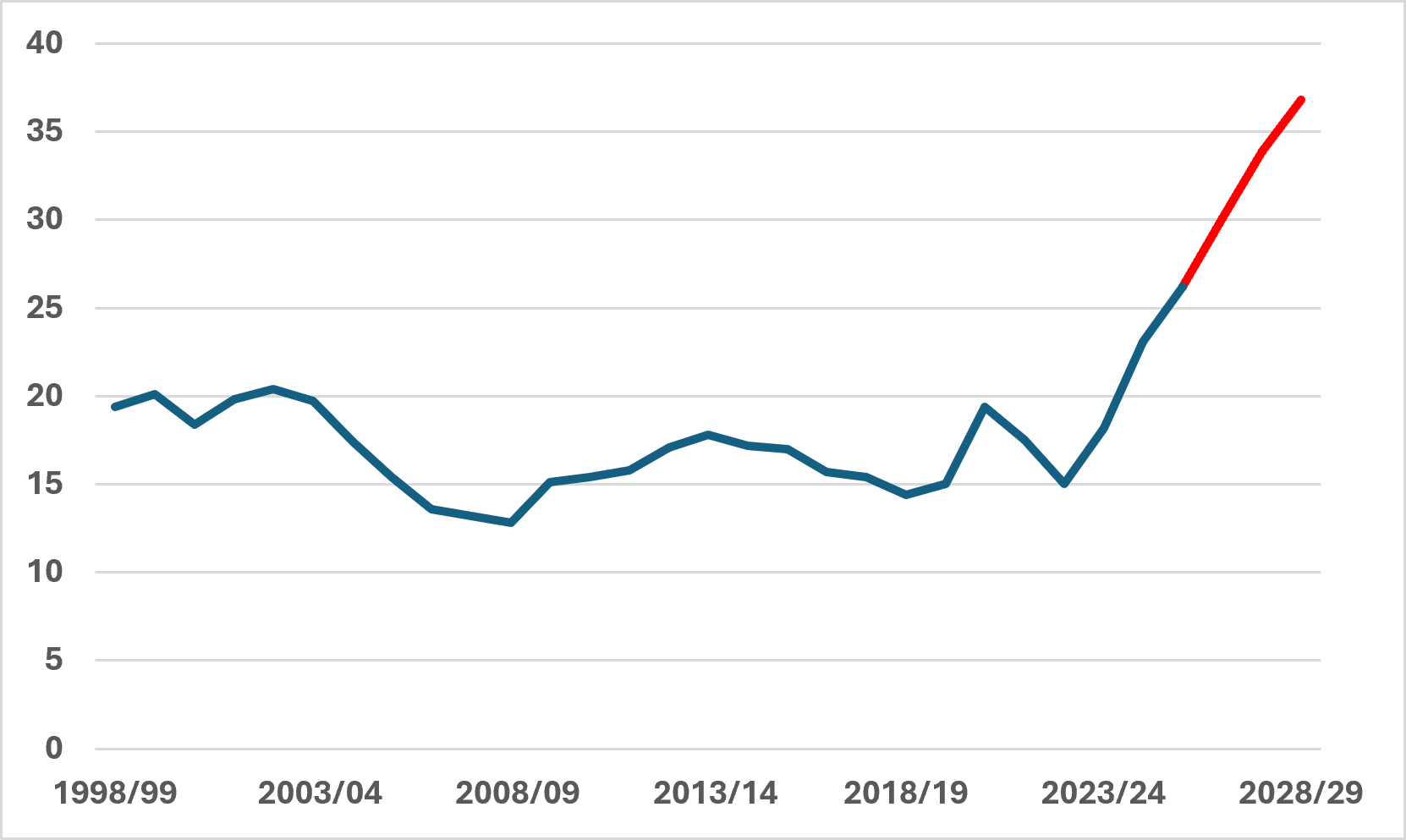
Between 1998/99 and 2019/20, this ratio fluctuated in a relatively narrow range – as high as 20.4% in 2002/03 and as low as 12.8% in 2008/09. These fluctuations tended to follow the state of the economy – falling from 2002/03 as the economy was relatively strong, rising after the 2008 Great Financial Crisis, and then falling again as the economy regained its footing after 2013. By 2018/19 it had fallen back to 14.4%. Then the Covid Pandemic happened, and we saw a sharp jump up to 19.4% in 2020/21 as economic activity was constrained while government expenditures rose. This was unwound in the two subsequent fiscal years, and the ratio was down to 15% by 2022/23.
Since 2022/23 there has been a steady increase – to 26.2% by 2025/26 and projected to rise further to 36.8% by 2028/29.
As the debt-GDP ratio rises, an increasing percentage of government revenue must be allocated to paying interest on the debt. In the short term, governments can avoid having that “crowd out” program expenditures by borrowing ever larger sums of money. But that means ever greater interest must be paid. Figure 2 below shows how the “interest bite” – interest payments as a percentage of government revenue has risen/will rise between 2022/23 and 2028/29, with the red portion again representing the most recent Ministry of Finance forecast.
Figure 2 – Interest Bite of Taxpayer-Supported Debt
(Interest Payments as % of Revenue)
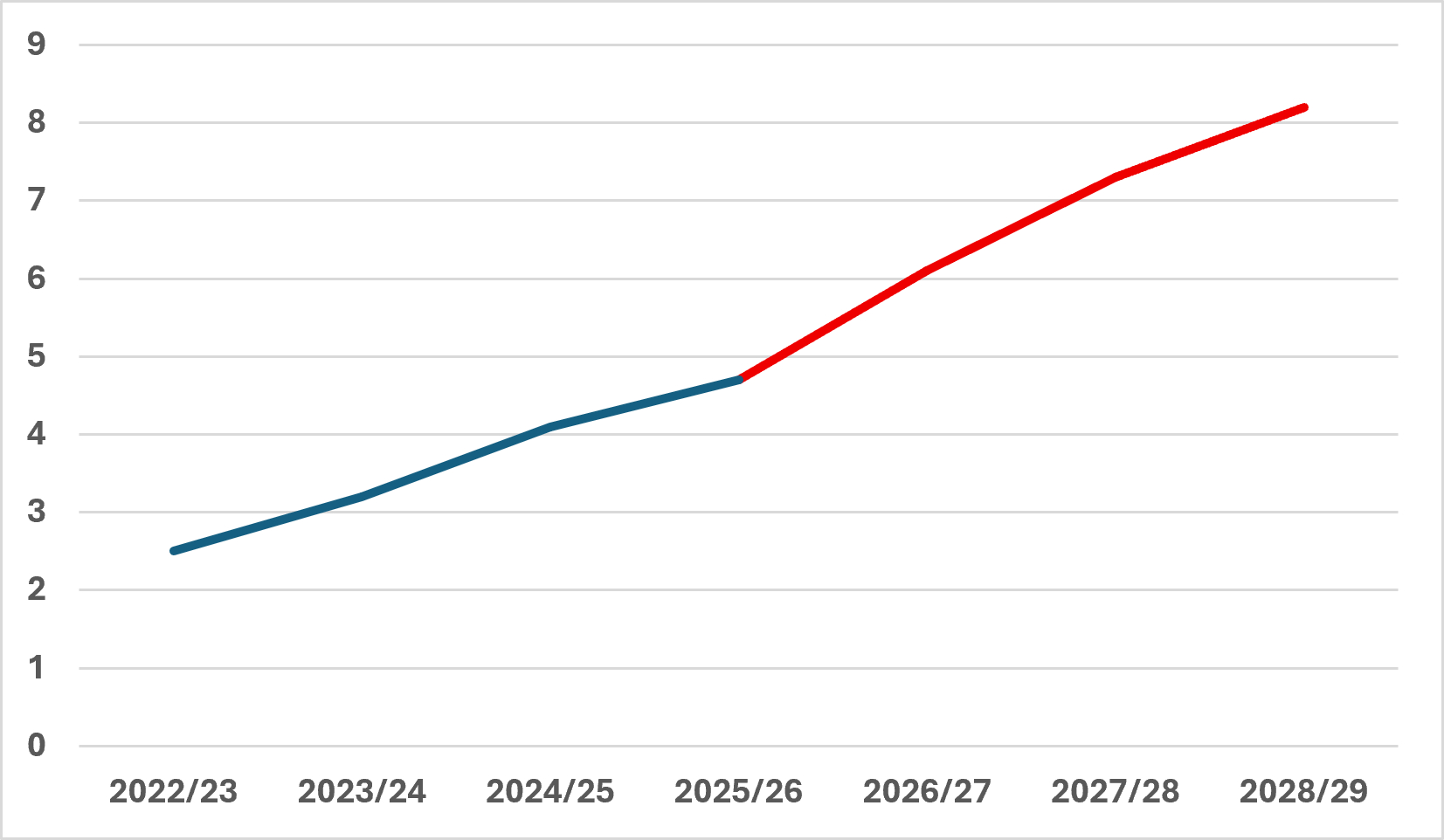
Without corrective measures, there would be no reason to expect the upward trend would not continue beyond 2028/29.
It is likely, however, that corrective measures will have to be taken. If the government does not proactively take such measures, capital markets will, at some point say, “enough!” and the Province will find it increasingly difficult to sell its bonds. This has already started, with successive downgrades from the credit rating agencies, meaning that British Columbia must pay somewhat higher interest rates. But at a difficult to predict moment, capital markets begin to lose confidence in a jurisdiction’s ability to manage its fiscal health, and it becomes impossible to sell more bonds at any reasonable interest rate, and a “day of reckoning” is forced upon it.[1]
This day of reckoning may sound fanciful, but there is an actual Canadian precedent of that happening. In the early 1990s the NDP government in Saskatchewan, having inherited large deficits and debt levels from the previous Conservative government, found it increasingly difficult to sell its bonds in capital markets, and could only do so with an implicit guarantee from the Federal government. Its debt-GDP ratio topped out at 37.2% in 1992/93. It was forced to embark on an exercise of radical downsizing of government – among other elements this involved closing many rural hospitals – that reduced per person program spending by more than 20%.
As this example of Saskatchewan should make clear, this is not a question of ideology or values – a centre-right government had run up the debt, and it was left to a centre-left government to repair the damage. It is simply a question of arithmetic.
So, my advice for the incoming government: don’t allow yourself to get on the wrong side of the arithmetic. Put in place from the start a credible path to fiscal sustainability. Do that through your own rational, credible plan before the capital markets do it to you.
As to what that looks like, I suggest stabilizing the debt-GDP ratio at approximately 33.3%. There is nothing inherently magical about that number. The key point is that the inexorable rise of the debt-GDP ratio must be stopped, and that must happen soon enough, and with enough real impact, that capital markets will view it as real and credible. On the other hand, targeting a lower debt-GDP ratio would entail radical program reductions rather than more digestible reforms to program delivery.
This will not be easy or painless. I estimate it will mean reducing the government’s borrowing requirements by approximately $3 billion in 2027/28 and $18 billion in 2028/29 below those in the fiscal plan of the outgoing government. Stronger economic growth from the measures outlined in the Conservative platform can be part of achieving such reductions because additional economic growth will generate more government revenue. I doubt, however, that, on its own, would be sufficient in the short period of one election cycle.
What would be the implications for the new government if it does not set itself on a credible path to fiscal sustainability? Although I said above that the point at which capital markets lose confidence in a jurisdiction is difficult to predict, I will hazard a guess that, on its current trajectory, British Columbia will reach its “Saskatchewan moment” sometime in the 2029/30 fiscal year. Would that be a great situation the year before the next general election?
I will leave it there for now.
[1] I cannot resist citing Hemingway’s classic passage from The Sun Also Rises: “How did you go bankrupt?” “Two ways. Gradually, then suddenly.”